Gaslighting a Death
How federal power, political extremism and Dan Dow distorted the killing of Renee Good

By now, we’ve all seen the pattern: a killing by law enforcement, a rush to sanctify the shooter, and an official narrative that hardens long before the facts have had time to breathe. What happened last Wednesday morning, when an ICE agent fatally shot Renee Good, 37, fits squarely and chillingly within that tradition.
Federal officials immediately claimed Good rammed an ICE agent with her SUV, forcing the agent to fire in self-defense. It was a clean story. Too clean. And like so many others, it began to unravel the moment independent scrutiny entered the picture.
A New York Times analysis of multiple videos tells a very different story. The wheels of Good’s car were angled away from the agent. The agent stood to the left of the vehicle, not in its path, and his feet were pointed away as the SUV passed — details that strongly suggest he was neither struck nor targeted. Eyewitnesses corroborated this account. Policing experts told outlets like the Washington Post and CBS News that the agent appeared to place himself in unnecessary danger, contradicting decades of tactical training that emphasize movement, cover, and de-escalation — principles laid out plainly in the Department of Justice’s own manual.
Under ordinary circumstances, such discrepancies would demand a transparent, multi-layered investigation. Instead, the FBI swiftly took sole control of the case, cutting state officials off from evidence. Minnesota officials, including Hennepin County Attorney Mary Moriarty, have raised alarms that this federal lockdown could prevent an independent review. If federal authorities were confident their account would withstand scrutiny, secrecy would be an odd choice. Transparency, after all, is what you lean on when the facts are on your side.
Into this vacuum rushed politics.
President Donald Trump wasted no time declaring on Truth Social and in interviews that Good “violently, willfully, and viciously ran over” the agent, who Trump claimed was hospitalized and “lucky to be alive.” Minneapolis Police Chief Brian O’Hara, by contrast, stated plainly that Good was the only person injured. Video evidence supports O’Hara, not Trump. Still, DHS Secretary Kristi Noem and others escalated the rhetoric, calling the shooting an “act of domestic terrorism” and branding Good a “violent rioter” who “weaponized her vehicle.” There is no evidence of a riot. Witnesses and local officials described Good as a legal observer, a neighbor supporting immigrant families, a mother who had just dropped her child off at school.
Facts mattered less than the story power wanted to tell.
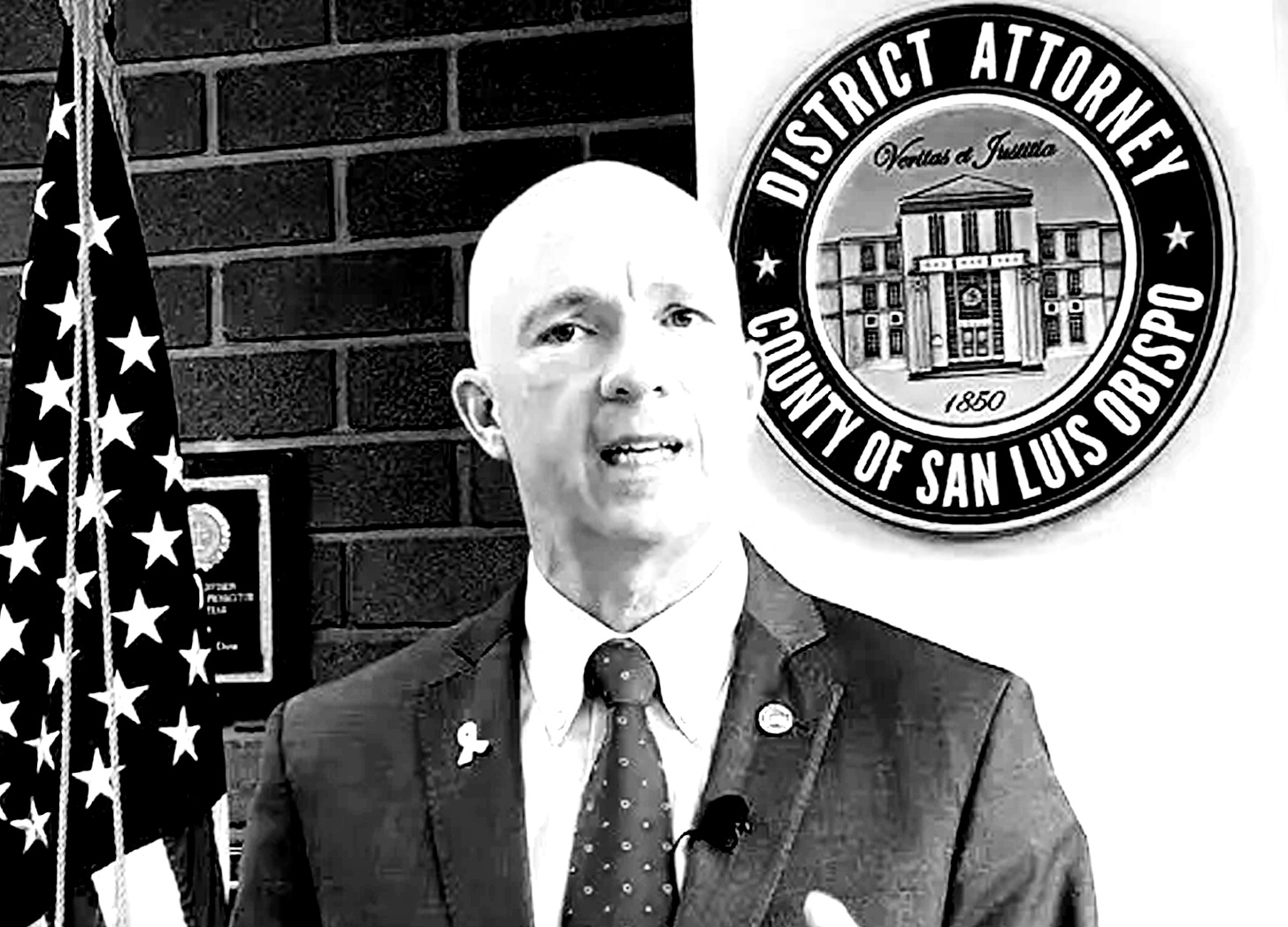
What makes this episode even more disturbing is how far the distortion traveled. San Luis Obispo County District Attorney Dan Dow — thousands of miles from the incident and with no jurisdictional role — used the killing as a cautionary tale, warning the public not to “interfere, obstruct, or delay law enforcement.” His message was unmistakable: challenge authority, and death is a foreseeable consequence. This, despite extensive video evidence showing no intent by Good to use force at all.
Dow went further, sharing commentary on X from Dries Van Langenhove, a Belgian far-right activist and founder of a youth organization a court found trafficked in racist, Nazi, and Holocaust-denying speech. Van Langenhove was convicted in 2024 for inciting violence and undermining democratic society in pursuit of white supremacy. That an American district attorney — an Army veteran, no less — would amplify such a figure is jarring. It is especially so given Dow’s recent history of smearing New York City’s newly elected mayor, Zohran Mamdani, by linking him to the September 11 attacks because of his Muslim faith.
Predictably, the online mob followed Dow’s lead. After The Tribune reported on his remarks, supporters flooded social media with homophobic slurs, denial of plainly visible video evidence, celebrations of Good’s death, and grotesque AI-generated imagery. This wasn’t just cruelty. It was gaslighting, an attempt to bully reality itself into submission.
That is where the real danger lies.
An elected official has a duty — not just political, but fiduciary and moral — to lower the temperature when national tragedies reverberate locally. A district attorney, serving in a role meant to be nonpartisan, should be acutely aware of how public commentary can poison jury pools and chill dissent. When that official instead chooses provocation, ideological alignment with extremists, and reckless commentary untethered from evidence, the damage extends far beyond one case.
Renee Good is dead. The facts of her killing remain disputed. What should follow is humility, restraint, and a rigorous search for truth. Instead, we are watching institutions close ranks, narratives calcify, and elected officials exploit tragedy to reinforce the oldest lesson of all: that power need not be right. It merely needs to be loud.
The question now is not only what happened on that residential street, but whether our justice system still has the courage to find out.